
How to implement SAP Digital Manufacturing
In many manufacturing plants, the daily reality looks like this: a machine is down, and nobody knows why. The ERP system provides data, but not at the moment when it is actually needed. Information from the shop floor arrives late, employees manually reconcile processes, and decisions are based on estimates rather than real-time data.
This is why more and more companies are turning to SAP Digital Manufacturing (SAP DM). But while the benefits of the platform are obvious, one factor ultimately determines success: How do you implement SAP DM, and how do you ensure that the solution operates reliably across all plants?
In this article, we show the steps that truly matter in practice and what you should pay attention to from the very beginning.
Why SAP DM matters now
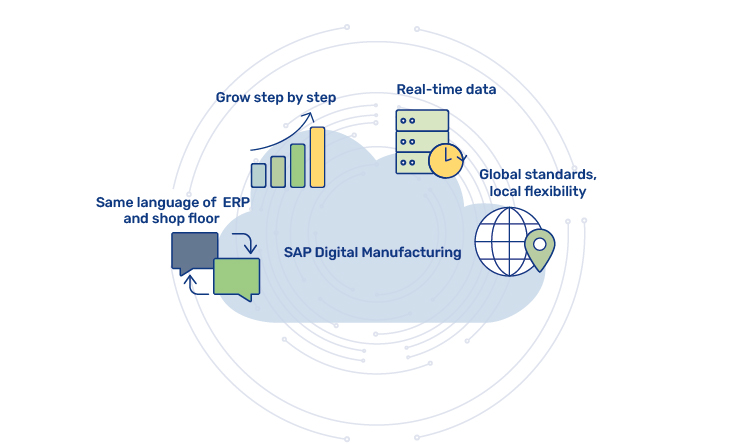
SAP DM brings transparency and speed to manufacturing, but above all, it makes it possible to solve problems where they arise: directly on the shop floor.
What SAP DM delivers in practice
- Real-time data instead of guesswork
You identify deviations immediately and reduce downtime and scrap. - ERP and the shop floor speak the same language
Data flows automatically, manual entries are eliminated, and errors decrease. - Start small and grow step by step
Begin with one plant or process and expand once the foundation is in place. - Global standards, local flexibility
Create consistent processes without forcing every plant into the same model.
Implementing SAP DM is less a technical project and more a structural evolution of manufacturing. The approach you take is therefore critical.
1. Don't rely on assumptions – analyze your current situation
Before starting implementation, you should have a clear understanding of how your processes, data, and systems work together today. Which processes run reliably? Where do process breaks occur? Which data is missing? A Discovery and Fit-Gap phase provides a clear analysis. It forms the foundation for every successful SAP DM project.
2. Test early – a proof of concept (PoC) quickly shows what works
Start with a pilot plant or a clearly defined process. A PoC shows whether your use cases work technically, what your data quality actually looks like, and whether the organization is ready. This reduces risk and provides valuable insights for the later rollout.
3. Define your roadmap – and keep it clear
A roadmap helps you manage complexity. Define early what you will implement and in what sequence, who takes on which role, and how much time individual phases will realistically require. A clear plan ensures that all plants and teams operate within the same framework.
Global, local, or hybrid: choose an approach that fits your organization
SAP DM projects rarely take place at a single site. To ensure that your implementation remains scalable, you should decide early on how you want to proceed.
Global template: You define central standards, processes, and data models. This creates efficiency and comparability.
Local adaptations: Each plant retains the flexibility it needs for its processes. This increases acceptance and helps ensure that the solution is actually used.
Cluster-based approach: You implement SAP DM step by step across regional or organizational groups. This reduces complexity, especially in global manufacturing networks.
Clear rules and measurable goals: Governance and KPIs make progress visible and provide guidance for everyone involved.
What successful projects have in common
From completed projects, we have identified the factors that are important in SAP DM projects:
- Engage all relevant stakeholders early. Whether on the shop floor, in IT, or among global process owners, the earlier you involve them, the faster acceptance develops.
- Invest in high-quality master data. Clean material, machine, and quality data determine how reliably SAP DM performs in practice.
- Plan technical integration carefully. SAP DM delivers its full value only when ERP, MES, machines, and shop floor systems communicate reliably with one another.
- Work iteratively. Small steps, short feedback cycles, and rapid adjustments reduce risk and noticeably accelerate implementation.
From idea to go-live: how we support you
Whether through a Discover Day, a proof of concept, or a global rollout, we support you throughout the entire journey, from the initial assessment to productive use across all plants.
With experience from completed projects and deep SAP expertise, we develop solutions that not only perform technically but also deliver real impact in practice.
