How Complex Technology Becomes a Functioning System as a Whole
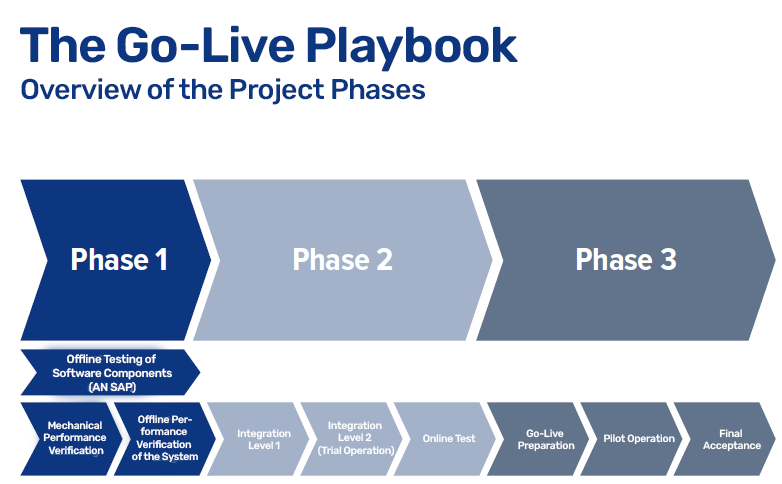
Whether conveyor or storage systems: Modern automation systems in logistics centers are masterpieces of engineering, software, and precisely defined processes. But there is one crucial step between installation and productive operation: commissioning. Only when all components mesh together like gears can availability, performance, and process stability be guaranteed. io supports this process with a clear procedural model for logistics commissioning. It is divided into three phases that build on one another:
Phase 1: ×
Laying the Groundwork—Mechanically, Software-wise, and Systematically
The starting point for any commissioning process is the mechanical performance assessment. Here, the focus is on the functionality of the system components—without any IT connectivity at this stage. At the same time, the so-called offline performance assessment takes place, during which assemblies and technical modules are typically tested without a connection to the Warehouse Management System (WMS). During this phase, the software is usually put through its paces in parallel: Using emulation and test data, the Warehouse Control System (WCS) and WMS are tested separately—functionally, on a large scale, and with regression testing. The goal: a stable and error-free foundation for integration.
Phase 2: ×
Integration and Load—The System in Interaction
Now the system is coming together. In Integration Phase 1, mechanical components and control technology are tested together for the first time, often under the integrated management of the logistics general contractor (GC). Integration Phase 2 brings real-world processes into play: test items, process staff, and IT systems interact for the first time. This creates a realistic test environment that reveals weaknesses before live operations begin. This is followed by the online test—a rigorous test using simulation data in which the entire integrated system, including WMS/WCS connectivity, is tested under full load. Throughput, availability, response times, stability: All aspects that will later influence operational success are quantified in advance. At the same time, this test serves as a crucial basis for the go-live approval.
Phase 3: ×
The Final Step – Stable Commissioning and Optimization
In the final “RampUp” phase, the system components are integrated and fine-tuned. Preparatory measures ensure the system’s operational readiness—from the training concept to process documentation. This is followed by trial operation: The system is gradually transitioned to live operation, accompanied by targeted optimizations carried out by the logistics and software general contractor. The process concludes with final acceptance testing. During this phase, the previously simulated performance is validated under real-world conditions—including an assessment of overall availability and compliance with all contractual performance metrics.

io as the driving force in the commissioning process
As an experienced logistics planner, io takes on a coordinating role throughout the entire commissioning process. In close coordination with the client, the logistics general contractor, and—if applicable—the IT general contractor, a binding commissioning script is created that defines all milestones, responsibilities, and interfaces. As an SAP Silver Partner, io can also directly handle the SAP implementation of solutions such as EWM and MFS to ensure successful IT integration of the logistics systems. This transforms many individual components into a fully functional, integrated system—with system performance you can rely on.