Investing in new production sites is one of the most strategically important decisions a company can make. At the same time, demands for speed, flexibility, sustainability, and technological integration are on the rise. In this interview, we discuss why traditional planning approaches often reach their limits and how Lead Consulting // plus helps make complexity manageable.
Why is the topic of master planning for industrial and manufacturing sites becoming so important right now?
The requirements for modern industrial projects have fundamentally changed. Today, companies no longer plan just a single building, but entire value-chain systems. Production, logistics, automation, IT, energy supply, sustainability, and future growth options must all be considered together from the very beginning. At the same time, demands for speed and investment security are increasing. Master planning is therefore increasingly becoming a strategic success factor because it integrates these disciplines and transforms many individual projects into a cohesive, end-to-end system.
Complexity is ubiquitous in virtually every large-scale project today. How can this complexity be made manageable?
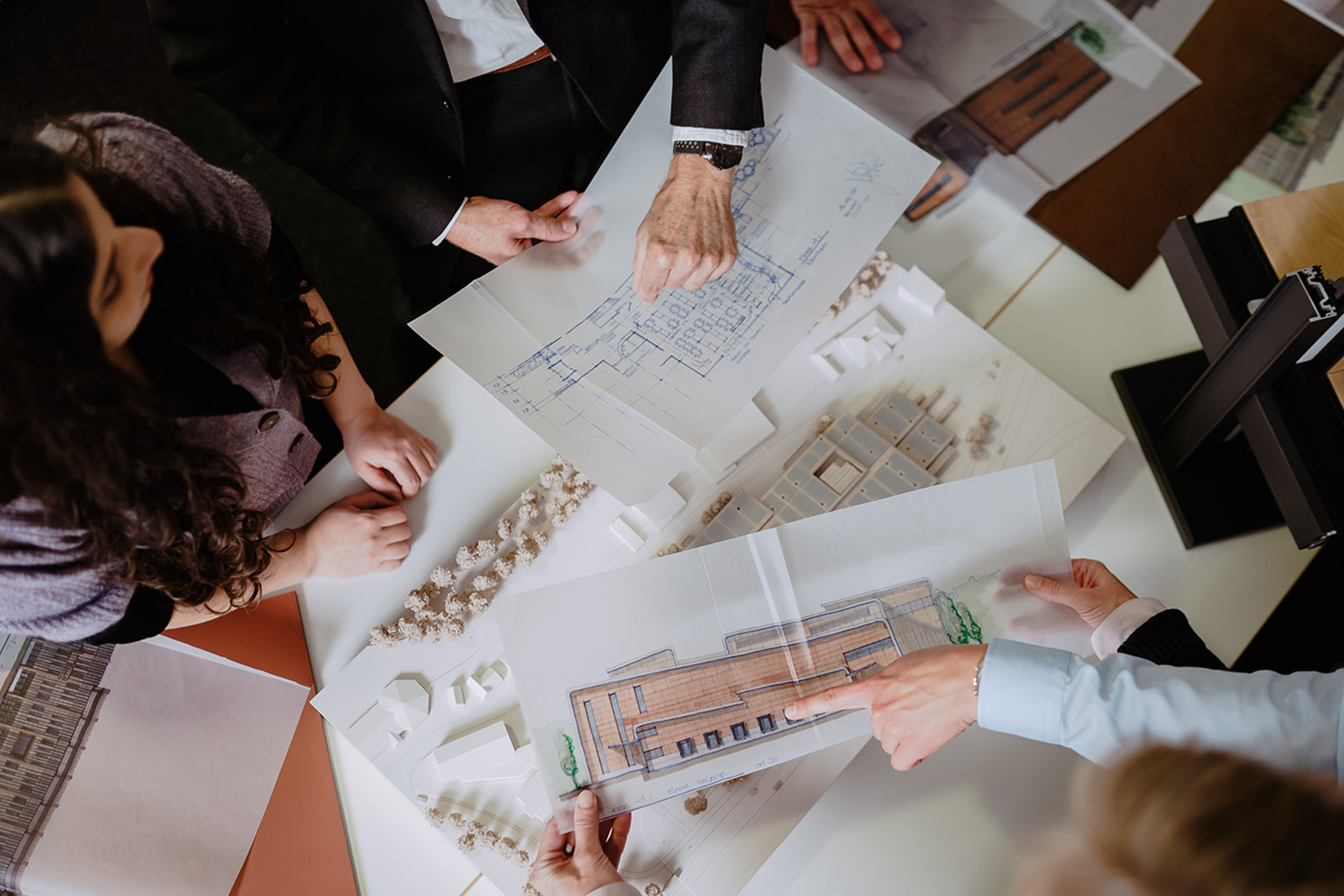
The real art lies not in reducing complexity, but in integrating it intelligently. Successful projects create a structure in which interfaces are not resolved only during implementation, but are already brought together in the concept phase. This is precisely where the added value of Generalplanung // plus lies: All relevant disciplines work toward a common vision from the very beginning, rather than sequentially within separate frameworks. From a management perspective, this means fewer conflicting objectives, clearer responsibilities, planning with fewer conflicts, and a management approach based not on reaction but on foresight. Complexity thus transforms from a risk into a predictable competitive advantage.
What risks arise when planning, architecture, production, logistics, and technical trades are not coordinated early on?
The consequences often do not become apparent until later project phases—but by then, they have a significant impact. A lack of coordination leads to costly re-planning, inefficient material flows, technical conflicts, or schedule delays. The situation becomes particularly critical when strategic decisions have already been made and necessary adjustments can only be made at great expense. From management’s perspective, therefore, it is not just about planning, but above all about minimizing risk. The earlier all relevant disciplines are integrated, the higher the quality of planning, cost stability, and reliability of implementation.
Investments in new production facilities often run into the tens or even hundreds of millions. What requirements do clients and investors place on modern master planning today?
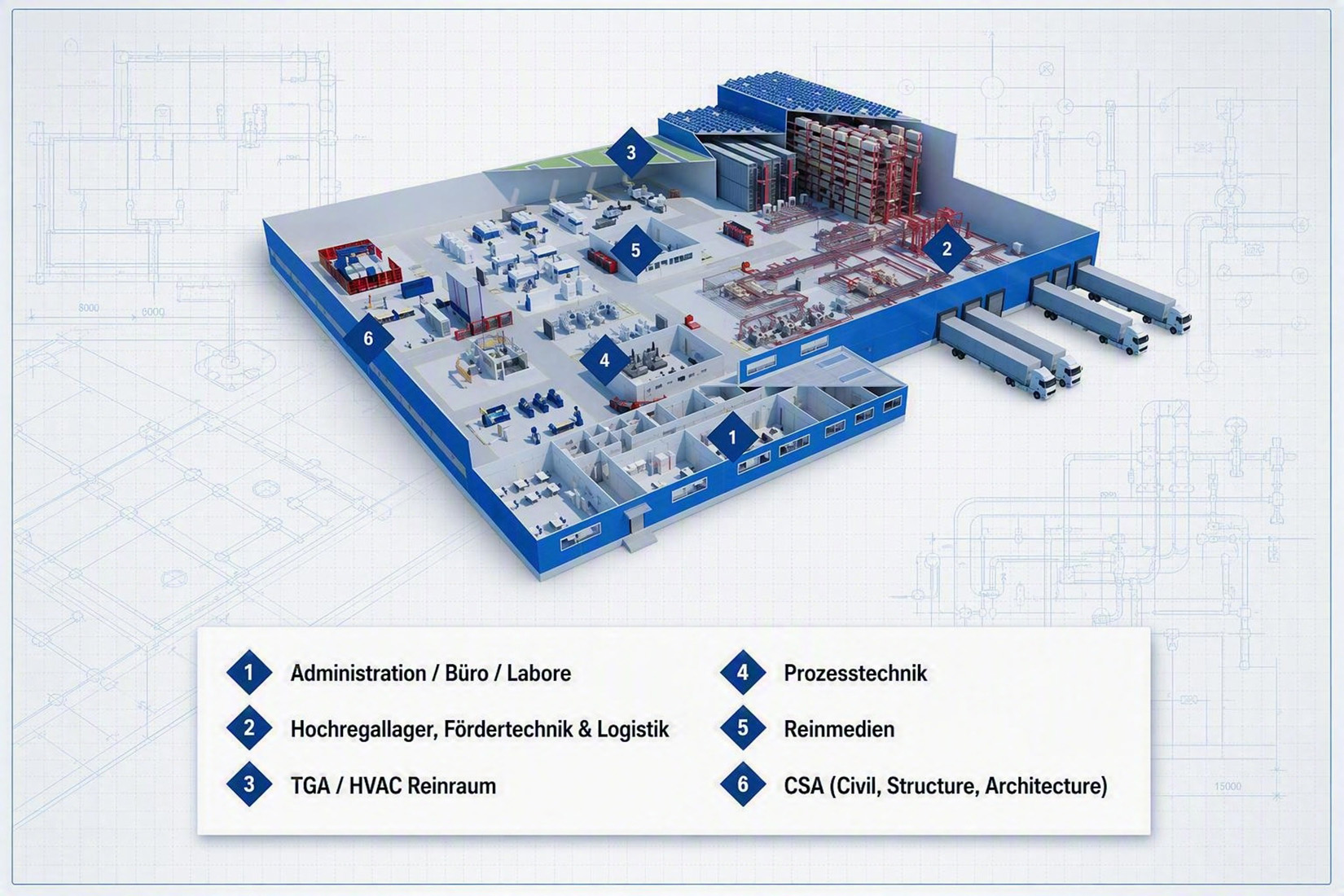
Those who make decisions today about investments in new production sites expect three things above all: transparency, reliability, and scalability. Transparency means a solid basis for decision-making regarding layout, processes, costs, schedules, and technical options. Reliability means that risks are not only documented but also actively managed and, as far as possible, concentrated with a single responsible partner. And scalability is crucial because a facility today must be designed not only for the initial launch but also to meet future product, volume, and technology requirements. The io approach reflects precisely this logic: from strategy and feasibility through concept, detailed planning, bidding, and implementation all the way to the start-up phase. Modern general planning must therefore do far more than simply coordinate planning documents—it must safeguard investments.
Digitalization, automation, and sustainability are fundamentally changing the demands placed on factories. How should planning approaches be designed today to take future developments into account from the very beginning?
The factory of the future must be prepared today for requirements that may become relevant in five or ten years. That is why it is not enough to simply address current needs. Successful facilities are designed for change. This includes modular building structures, flexible production and logistics concepts, scalable technologies, and data-driven planning. Sustainability is no longer an afterthought but an integral part of future economic viability. Companies need sites that they can continuously develop without losing their competitiveness.
The strength of Generalplanung // plus lies in the integration of a wide variety of disciplines. What specific added value does this approach create for the client?
The greatest added value of integrated general planning arises where different disciplines, requirements, and interests are successfully brought together: at the interfaces. When factory planning, logistics, production, architecture, building services, IT, and project management are planned and managed jointly, significantly better decisions result. Clients benefit from clear lines of responsibility, greater planning certainty, and significantly more efficient project execution. At the same time, this ensures that the building is not viewed in isolation but is optimally aligned with future production and business processes. The result is not only a functional facility but also a long-term competitive advantage.
If you could give a client just one piece of advice for planning a new production site—what would it be?
Don’t start with the building—start with your future business model. The crucial question isn’t, “How do we build a factory?” but rather, “What kind of value creation do we want to enable in ten years?” Those who consistently adopt this shift in perspective make better planning decisions and create sites that remain successful in the long term. The biggest investment in a project isn’t the building itself, but the strategic decision behind it.

Conclusion
The future of successful industrial projects lies not in the perfection of individual disciplines, but in their intelligent integration. Generalplanung // plus stands for an integrated approach that combines strategy, production, logistics, architecture, building services, IT, and project management into a seamless, comprehensive system. In an age of growing complexity, it is precisely this ability that becomes the decisive factor for success. After all, the art of successful planning does not lie in avoiding complexity—but in making it manageable for the client.