In many companies, the discussion surrounding SAP S/4HANA is still heavily influenced by technical issues. What is the right migration strategy? How much effort will it require? Which systems need to be integrated? Yet an ERP transformation involves far more than just technical issues.
Artificial intelligence, automation, international scalability, rising security requirements, a growing shortage of skilled workers, and ever-shorter innovation cycles are changing the demands placed on corporate management. At the same time, legacy ERP landscapes are becoming increasingly complex, more expensive to maintain, and harder to adapt to new business requirements.
So the key question is: What should the future ERP landscape look like to keep the company competitive in the long term? Answers to these questions were provided by the webinar “SAP S/4HANA – Clarity for Your Path Between Evolution and Transformation” from io.

The Key Drivers of ERP Transformation
Today, the discussion surrounding a new ERP strategy centers primarily on innovation capabilities, scalability, security requirements, the complexity of existing system landscapes, infrastructure investments, and the shortage of qualified IT resources. Added to this are demands for predictable operating costs and faster implementation of new features.
For many companies, this raises the question of which platform offers the best conditions for future growth, digitalization, and process optimization.
Brownfield or Cloud ERP: Two Different Approaches
When transforming to SAP S/4HANA, companies often face two fundamental paths. The brownfield approach aims to largely retain existing processes and structures and migrate them to the new platform.
The greenfield approach with SAP Cloud ERP, on the other hand, uses the transformation to reevaluate existing processes, align more closely with established best practices, and lay the foundation for an ERP landscape capable of long-term innovation.
The Future Is Taking Shape in the Cloud
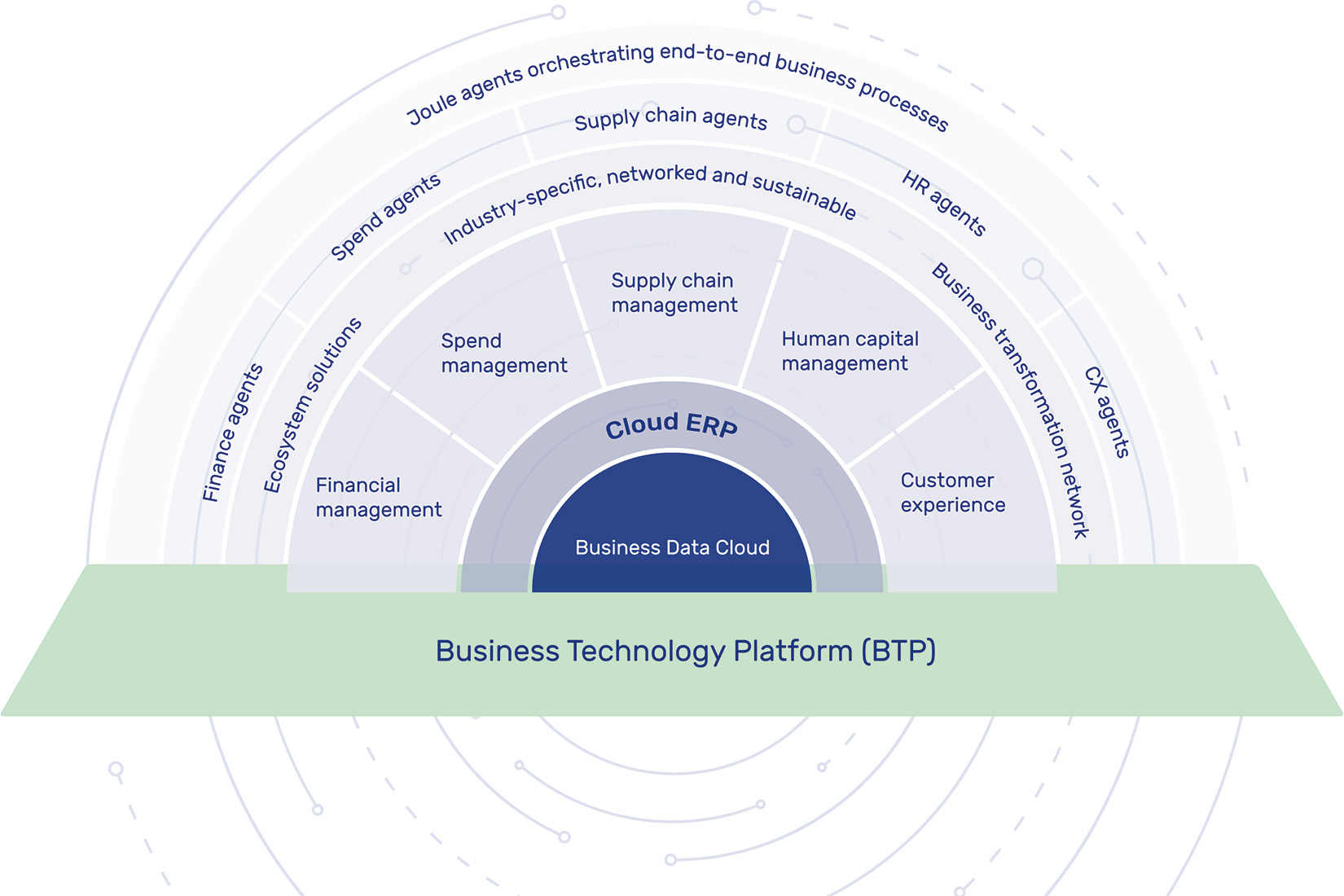
SAP’s strategic focus is clearly on cloud ERP. Innovations are increasingly being rolled out first for the cloud, particularly in areas such as AI, automation, modern user interaction, and the integration of new business services.
The SAP Business Suite plays a central role in this. It connects processes, data, and AI on an integrated platform and lays the foundation for data-driven applications and intelligent automation.
User interaction is also evolving. With SAP Joule, SAP is introducing an AI-based assistant designed to support users in their daily work and simplify routine tasks.
Transformation Doesn’t Start with IT
The result: ERP transformations are not purely IT projects. Success depends just as much on organizational changes. Cloud ERP is increasingly following the “Standard First” principle. Individual requirements can still be accommodated, but enhancements are made within clearly defined boundaries. This reduces complexity and allows innovations to be leveraged more quickly.
Discover FAST: Understand First, Then Decide
This is exactly where io’s Discover FAST approach comes in. Within just a few weeks, io analyzes processes, the system landscape, and the economic implications. “Fit-to-Standard” workshops also provide initial insights into the process coverage offered by SAP Cloud ERP and potential areas for optimization. The result is a well-founded basis for decision-making, including an assessment of the transformation options and their organizational, technical, and economic implications.
Clarity Before Transformation
It’s worth systematically evaluating the potential of modern cloud ERP approaches. Discover FAST offers a structured starting point for evaluating transformation options based on facts and deriving the right strategy for your specific requirements.
Discover FAST Self-Assessment
If several of these statements apply to your company, a structured assessment of your transformation options may be worthwhile.
✓ Yes | x No
- Our existing processes have evolved over time and no longer meet today’s requirements.
- Customizations, in-house developments, and interfaces prevent regular updates to our system and make it difficult to implement innovations.
- We want to reduce existing complexity and align our processes more closely with standards.
- Topics such as the cloud, AI, and continuous innovation are expected to play a central role in the future.
- We currently lack a reliable assessment of the effort, risks, and target vision for a potential transformation.
- We cannot yet say with certainty which transformation approach is best suited to our situation, both technically and economically.