Today’s factories are undergoing a transformation. But where are these transformation processes headed? Tobias Herwig, Business Unit Manager for Factory Design at io, sheds light on the matter: On his podcast *Factory of the Future*, he explores innovative concepts, smart technologies, and bold ideas that will shape the production environment of tomorrow. Since February 2021, he has been hosting weekly conversations with plant managers, factory planners, production managers, and other fascinating personalities. He discusses with them their visions for the future, best practices, and the courage needed to navigate the next industrial revolution.
The plant in Le Mans has a truly rich history. Claas acquired it from Renault in 2003, and the facilities are already 80 years old. What was the plant like before the renovation? What challenges did you face?
A plant with such old building structures tends to get darker and darker inside over the years. We had an established assembly line there with a wide variety of conveyor systems. In total, four different conveyor systems were in use, and the tractors had to be laboriously moved back and forth between them time and again. Efficient production of highly complex tractors with a wide technical range was hardly possible there anymore. Logistical requirements have also grown significantly due to the broader tractor model range—driven by the variety of variants, the number of parts, and the higher weights. New logistics concepts were needed to properly supply the lines and enable employees to assemble the tractors efficiently. The assembly line had to be completely restructured. This has been carried out over the past few years.
Did production continue uninterrupted during the three years of renovation? Or how long were the periods when production was temporarily halted?
Traditionally, production at our agricultural machinery plant shuts down for a few days in the summer. At the plant in France, this is usually four weeks in August. We made intensive use of this time for the renovation. During the rest of the time, we actually continued production continuously alongside the renovation work. This sometimes took place under very challenging conditions. We were able to effectively bridge certain gaps using backup solutions. Ultimately, we did not lose any production capacity due to the renovation compared to a normal year.
You mentioned that there used to be many different conveyor systems. How does the product now move through production?
We actually have various conveyor systems again, but they’re much better structured and coordinated with one another.
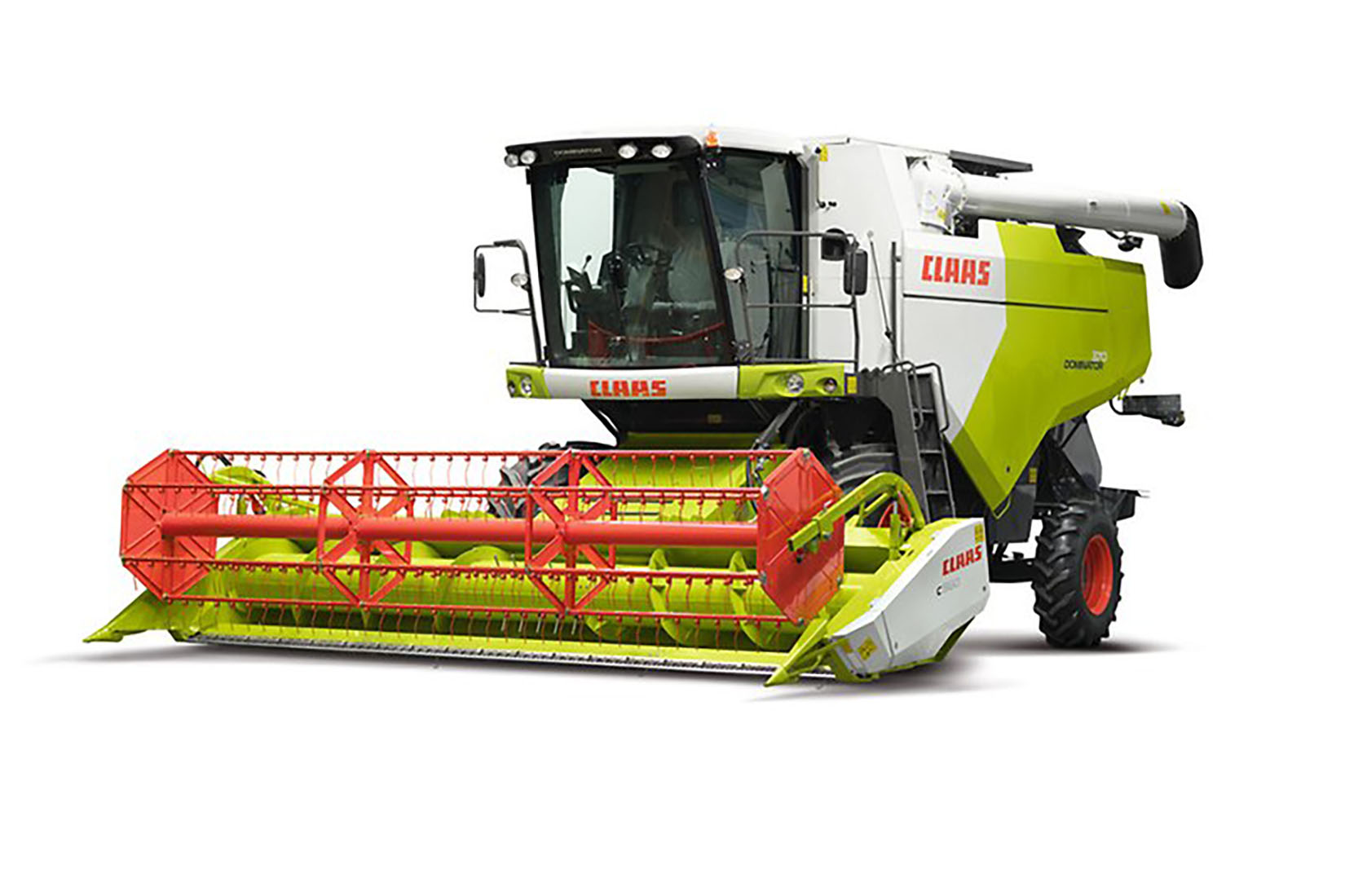
A good harvest means everything's good: Claas is one of the world's largest manufacturers of agricultural machinery.
There is a dedicated conveyor system for engine and axle assembly, as well as for work beneath the tractor. Based on this system, the tractor bodies are hoisted up and lowered again for the painting process. The main portion of the assembly line is operated by an automated guided vehicle (AGV). This gives us a high degree of flexibility in route planning. In the event of future process changes, it will be much easier than before to modify the route and extend or shorten the assembly line. In the future, flexible interlinking may also be possible, allowing vehicles to be fed into and out of the line.
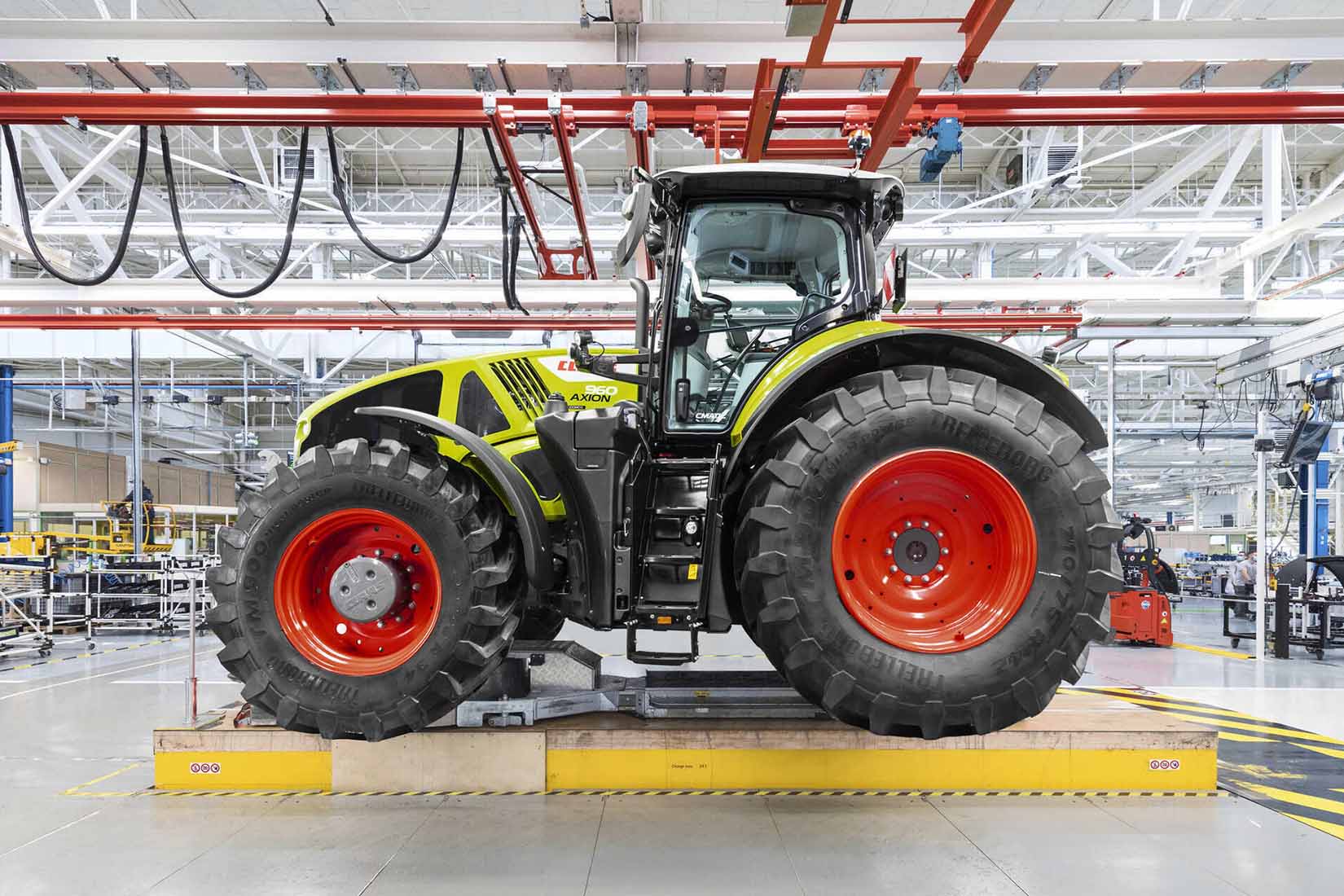
What does the material flow look like in terms of parts delivery? Is it automated, or are traditional automated guided vehicles (AGVs) used? Is there still potential for improvement in the future?
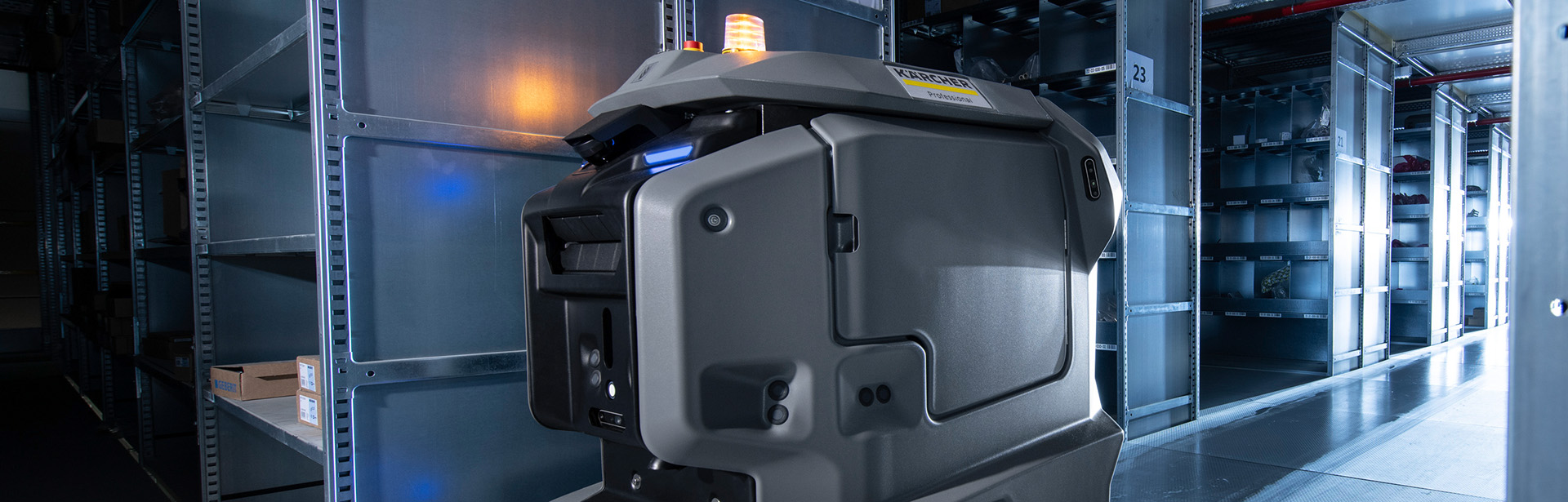
There is certainly still potential there. Today, the supermarket warehouses are located right next to the assembly line. Picking is therefore carried out close to the assembly line, and the picking carts are usually brought to the assembly line by hand. Where that isn’t possible, we generally use automated guided vehicles. Material replenishment is handled by automated guided vehicles (AGVs); for very large items, forklifts are sometimes used as well. One example of this is the delivery of tires. Tires are delivered to the plant “just-in-sequence” by a supplier, stored on trailers outside the plant, and transported by forklifts to the front of the production hall. There, they are picked up by an AGV—in this case, a driverless forklift—and transported to the workstation, ensuring, first, highly efficient and automated transport within the plant and, second, preventing dirt from outside from being brought into the production area.
Are there approaches for validating use cases for a staff-free factory, or for determining which assembly steps in such a final assembly process might be automated?
For us, one thing is clear: the factory of the future will not be unmanned. Rather, people are at the heart of the factory. We are constantly finding cases where automation is worthwhile.

However, when it comes to final assembly, I don’t see a workstation where only robots are operating at the end of the line. We tend to see automation more in pre-assembly areas, in the form of CO-bots, or to advance automation even without a large protective fence. Of course, we try to relieve employees of unpleasant, physically demanding tasks. But the solution often lies in mechanization or partial automation.
Concepts like matrix production or flexible cell manufacturing can completely transform factories that produce complex products with a high degree of variation. Do you think these concepts have a chance when looking five to ten years into the future?
I don’t entirely believe in the vision of matrix production—because I find it hard to imagine how such a factory could be synchronized to ensure an even workload across the workstations. I’d argue there are two ways to optimize: I can either optimize capacity utilization at the workstations as much as possible.
But then, at some point, my queue gets out of control. Or I optimize the queue. But then I can no longer maintain an even workload across my stations. I still find it difficult to optimize both at the same time.
In our finishing area, however, we’re taking a small step in that direction: While we keep the cycle time constant here, tractors with a smaller workload can leave the area faster than those that require more time. While this isn’t quite as dynamic as matrix assembly, we’re at least changing the order of the products. To sum it up: Matrix assembly will remain a vision for the next ten years. But I believe that this vision can teach us things that will set us on the path to matrix production without completely breaking away from the traditional assembly line.