How Sustainability Pays Off Right from the Start
Everyone is talking about sustainability—and it’s hard to define in a single, clear way. However, the idea that sustainability is not limited to reducing CO2 emissions is becoming increasingly accepted in everyday language. The academic definition of sustainability illustrates this. It breaks the concept down into its environmental, economic, and social aspects. These are closely intertwined—especially when it comes to business matters.

To survive in the long term, companies must first be economically sustainable—that is, sufficiently profitable. If they are also environmentally sustainable, they minimize their harmful impacts on the environment. Similarly, socially sustainable companies reduce any negative effects on the people with whom they interact. In addition to employees, this also applies to suppliers and neighbors.
The crux of the matter is this: there is likely no industry or company where conflicts of interest do not arise between these three areas. Resolving them requires the right measures. These must always be tailored to the specific company or project—while keeping the big picture in mind. This is true regardless of the fact that individual measures are always assigned to a specific area, such as production. The general planners at io understand this—and support their clients with holistic concepts that consistently take into account all effects that extend beyond the immediate scope of the project. Only in this way can sustainability be achieved at all levels.
Experience shows that measures are particularly effective when they are integrated into the planning process at an early stage—provided they are based on broad technical expertise. In such cases, they can significantly reduce overall costs—and, on top of that, minimize negative impacts on people and nature. Specifically, this means, for example, continuously tracking greenhouse gas emissions throughout the entire planning phase and using them as an additional criterion. These emissions are subject to costs or taxes, which—similar to value-added tax—are passed along the value chain. This gives them financial significance.
Optimization of Energy and Operating Costs ×
Government Incentives for Sustainable Renovations ×
Under the Sustainable Building Quality Seal (QNG) program, renovation projects are eligible for government subsidies of up to 1.5 million euros per building—provided they do not exceed a greenhouse gas emissions threshold based on usable floor area. Those who want to play it safe in this regard should rely on early and continuous GHG accounting.
In addition to these benefits, which are realized directly during the construction phase, sustainable buildings offer further advantages that often extend over their entire life cycle—that is, over several decades:
- Reduced energy costs
- A positive image as a sustainable company among customers, neighbors, and current and future employees—which in turn leads to reduced costs for recruiting and onboarding
- Lower renovation costs – Greater value retention of the building
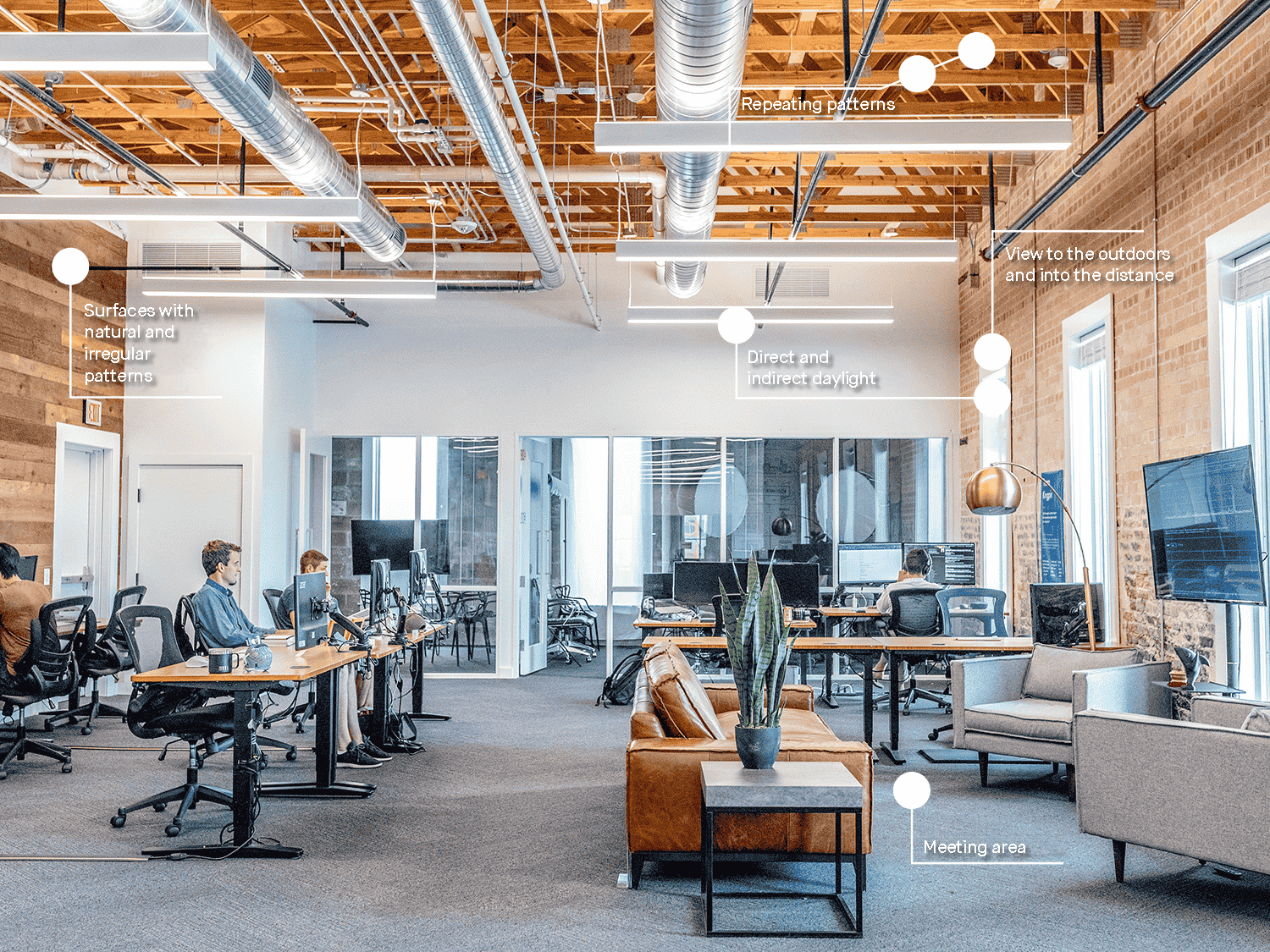
Buildings can not only be environmentally sustainable but also contribute substantially to the social sustainability of companies—it’s all a matter of planning. The necessary measures result in only minimal additional planning and construction costs. On average, these costs are less than five percent and lead to various improvements, as scientific studies show.
For example, productivity increases by…
- a view of the outdoors by up to 6.7 percent,
- natural or mixed ventilation by up to 9.8 percent, and
- sufficient natural light by up to 15 percent...
Low-cost measures such as these can be incorporated into the planning phase at minimal expense and implemented later.
On top of that, industry publications confirm additional benefits for companies with sustainably designed buildings:
- Better employee retention and fewer new hires
- Higher revenues, especially in the end-customer market
- Lower depreciation of the property
- Less need for renovations
If, for example, these measures are assumed to result in annual personnel cost savings of 2 percent, a manufacturing company could reduce its annual personnel costs—say, 40 million euros—by 800,000 euros. Similarly, the higher mental performance of employees leads to less waste. With material costs of 200 million euros per year, an increase of 0.5 percent results in annual savings of one million euros.
These examples show that a sustainable approach offers more opportunities for savings—starting as early as the initial planning phase—than simply minimizing energy costs and reducing greenhouse gas emissions. These opportunities span all areas of the business—and have a positive long-term impact. Those who wish to benefit from them would therefore be wise to adopt a holistic planning approach from the very beginning.