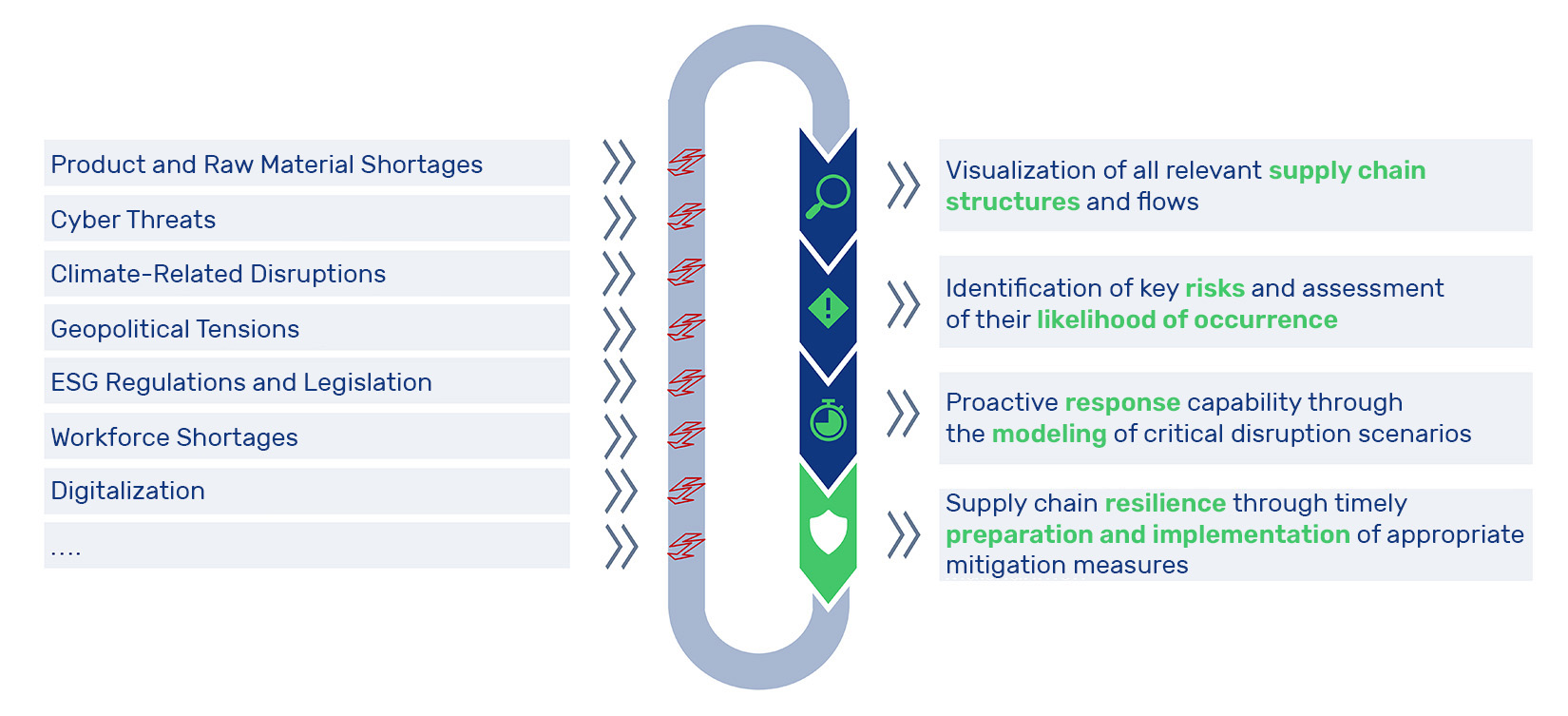
Global supply chains and their volatility are increasingly presenting logistics professionals with their greatest—but also most interesting—challenges. When cyberattacks cause production stoppages that can sometimes last for weeks or months; when an accident hinders the timely delivery of time-sensitive products; when air traffic restrictions prevent needed materials from being delivered on time; when new tariffs increaseimport or export costs—or even necessitate additional bonded warehouses—all of these are challenges that affect the efficiency and effectiveness of the supply chain and its smooth operation. This calls for a systematic and structured analysis of potential disruptive factors and a corresponding optimization of supply chains to identify potential risks early on and initiate a rapid response.
DICE: The io Process Model
What does such an analysis of business processes look like? The DICE (Data, Impact, Controlling, and Execution) process model, developed by io for this purpose, is based on a data-driven concept for identifying and assessing the respective probability of occurrence of negative factors and the associated risk scenarios. Based on its results, measures to mitigate the impact of disruptions can be defined, forming the basis for the creation of a resilience roadmap.
Risk identification is based on mapping the supply chain, taking into account logistical, geopolitical, and social risks as well as their probabilities of occurrence. In this way, io can model specific disruptions—and use its Supply Chain Cockpit to visualize their impacts on specific node types such as suppliers, production facilities, and distribution centers. What are the suppliers’ processing and replenishment times? What procurement strategy does the external logistics provider follow? What is the current market demand for the company’s own products? The io Supply Chain Cockpit provides clarity amid the data jungle surrounding these and other questions.
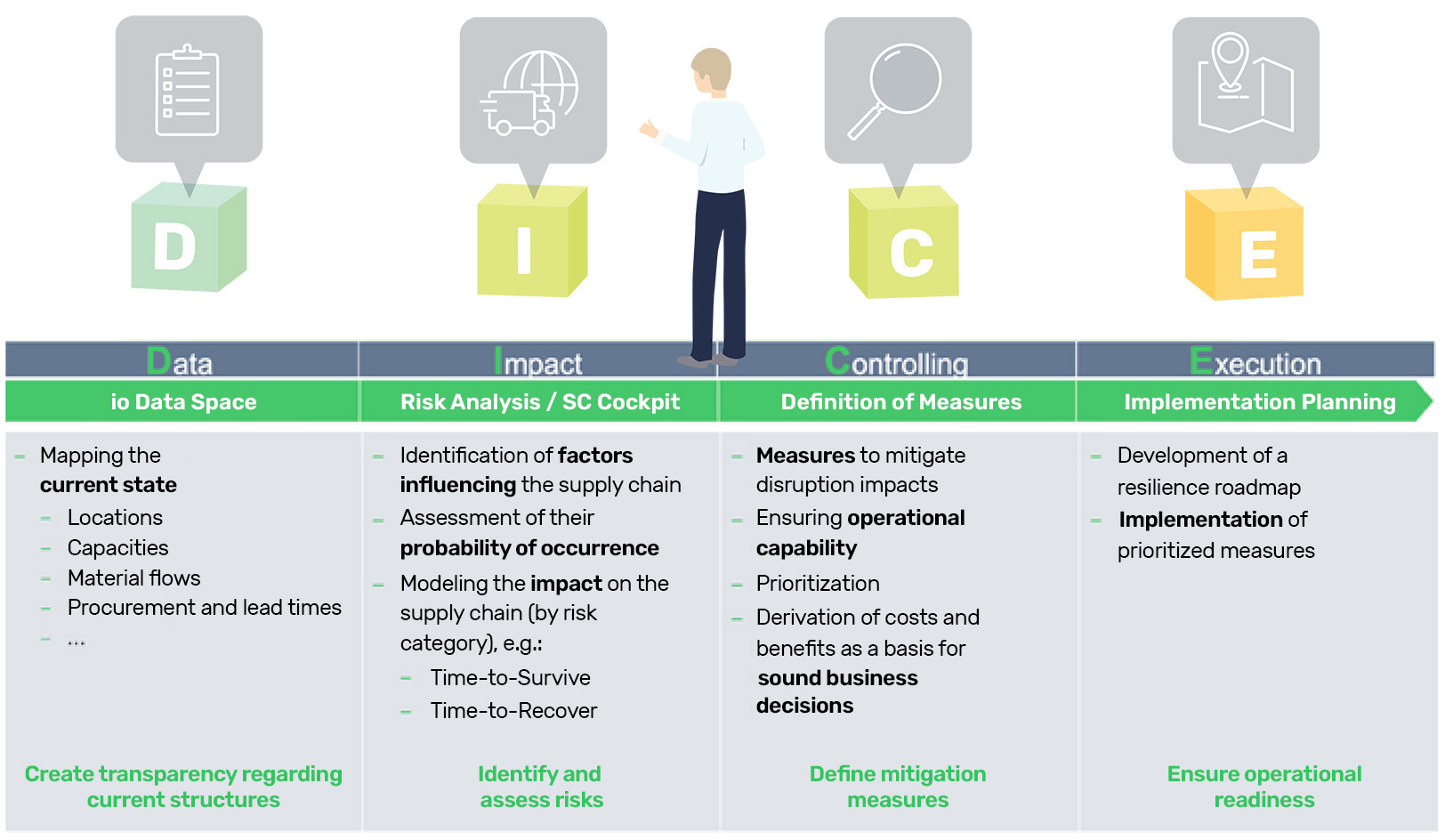
In this way, the Supply Chain Cockpit serves as a co-pilot for the interdisciplinary io experts. This allows the undesirable effects of specific disruptions to be quickly identified—and targeted measures to prevent disruptions and ensure operational readiness to be swiftly implemented.
Through the development and implementation of a resilience roadmap, the effectiveness of defined measures is monitored, while flexibility and resilience are further enhanced through a rolling process. This minimizes the negative impacts of defined risks and continuously increases the resilience of the supply chain.