Many manufacturing companies face the same challenge: their energy supply systems need to be replaced or expanded. Often, the decision is made in favor of the solution with the lowest upfront investment costs. However, what appears economical at first glance often turns out to be the more expensive option over the system’s entire service life.
Particularly when it comes to heat and power generators such as heat pumps, photovoltaic (PV) systems, combined heat and power (CHP) plants, or conventional boilers, it is therefore important to consider not only the initial investment but also the total life-cycle costs.
From Investment Costs to Total Costs
Capital costs cover only the expenses for planning, procurement, and installation of a system. However, other cost factors play a decisive role in actual cost-effectiveness, often accounting for more than 70% of the total life-cycle costs.
- Energy costs during operation
- Maintenance and servicing costs
- Costs for repairs and replacement parts
- Decommissioning and disposal costs
- Subsidies and tax benefits
- Residual values at the end of the useful life
The sum of these factors constitutes the life cycle costs (LCC).
Operating costs are becoming increasingly important, particularly in times of rising energy prices and stricter requirements for CO₂ reduction.
It is not uncommon for these costs to amount to several times the original investment over the lifetime of a system.
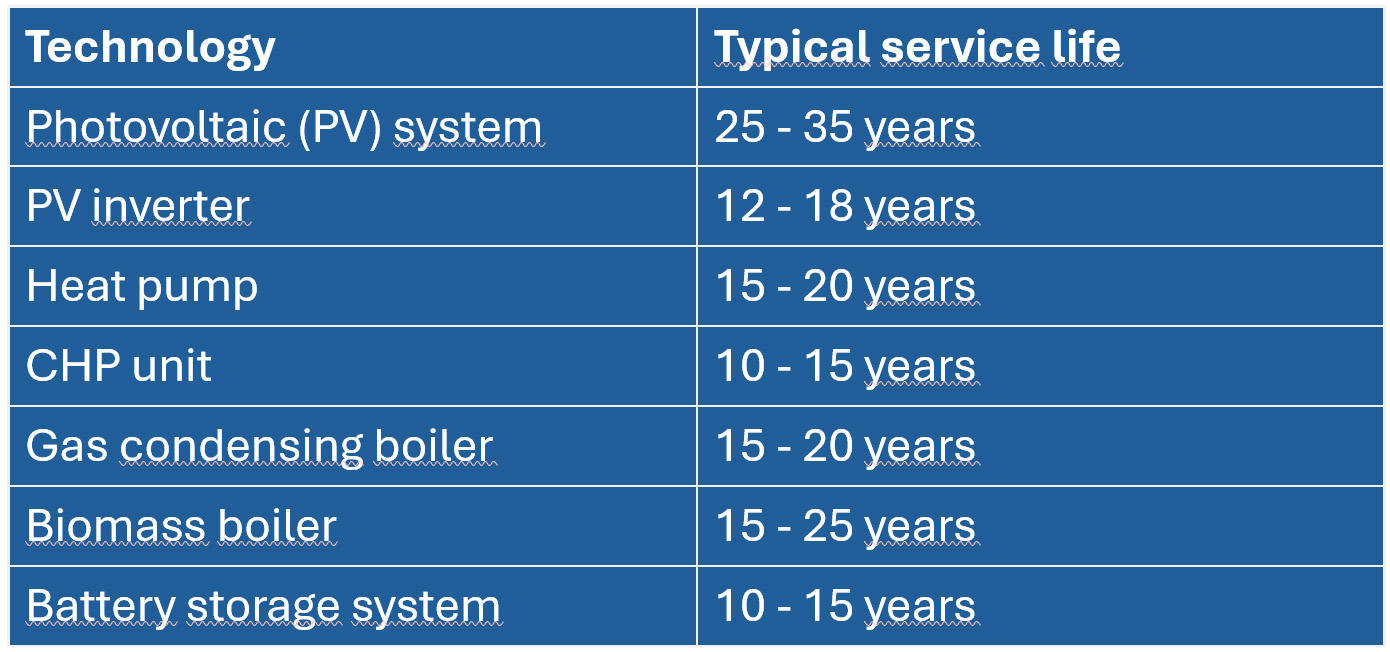
The differences are significant: While a PV system often generates electricity for over three decades, several major components in CHP plants must be replaced or thoroughly overhauled during that time.
Typical service lives of energy systems
The technical service life is a key factor in analyzing life-cycle costs.
Real-World Example: Higher Investment, Lower Total Costs
A medium-sized manufacturing company requires approximately 500,000 kWh of electricity and 700,000 kWh of heat annually. The choice is between:
Option A
- Gas condensing boiler
– electricity from the grid
Option B
- Large heat pump
– photovoltaic system
– load management
The investment costs for the heat pump solution may be 40 to 60% higher than those for the conventional option. However, when considering a 20-year lifespan, energy costs are typically significantly lower. At the same time, a portion of the electricity demand is generated on-site, which reduces dependence on future electricity price increases. Especially for businesses with high electricity demand during daytime hours, the combination of a PV system and a heat pump can be particularly economically attractive, as a large portion of the solar power is used directly on-site.
ROI: What Are the Expectations of Mid-Sized Companies?
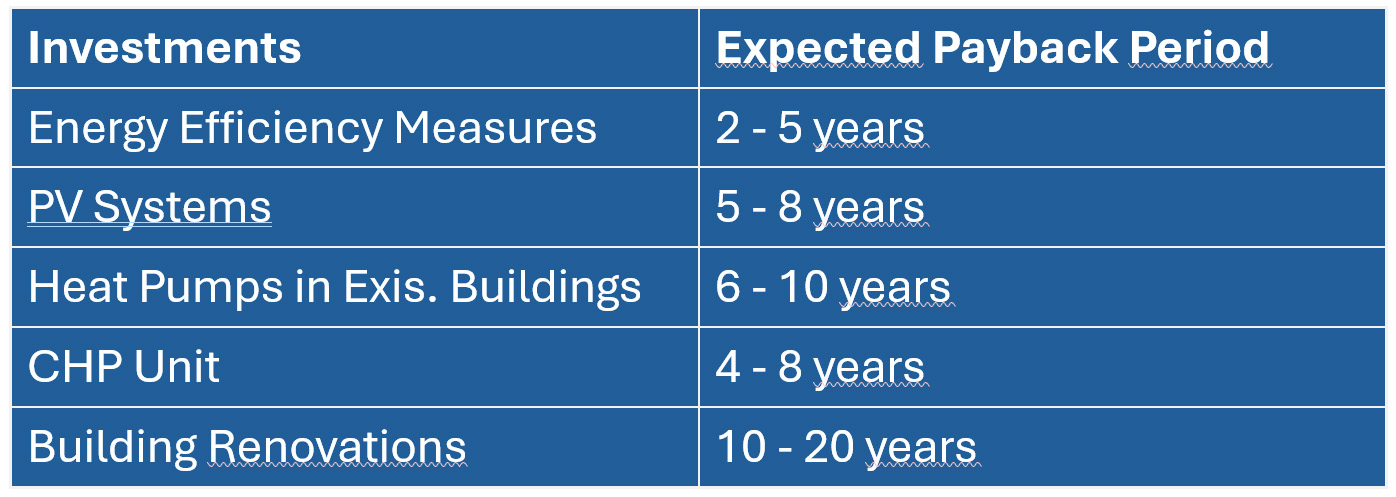
In discussions about profitability, we often encounter the question: “When will the investment pay for itself?” While large corporations pursue long-term sustainability goals and often evaluate investments over a period of ten to 15 years, expectations in traditional small and medium-sized enterprises are usually significantly shorter. Many companies base their decisions on internal return-on-investment requirements of about 8 to 15% per year. Investments with longer payback periods are often implemented only if they offer additional benefits, such as:
- greater security of supply
- legal requirements-ESG criteria
- CO₂ reduction
- enhanced reputation among
customers and investors

CHP or Heat Pump?
A comparison between CHP units and heat pumps is particularly interesting right now. CHP units offer the following advantages:
- good cost-effectiveness
for year-round heating needs
- simultaneous electricity and
heat generation
- often short payback periods
In contrast, heat pumps offer:
- no direct on-site CO₂ emissions
- high efficiency (annual performance
factors of 3 to 5)
- excellent compatibility with
photovoltaic systems
- high future-proofing with regard
to regulatory requirements
The economically optimal solution depends heavily on the company’s individual load profiles and energy prices. There is no one-size-fits-all recommendation.


Conclusion
The cheapest system is rarely the most cost-effective
For medium-sized manufacturing companies, the investment amount should never be the sole deciding factor. What matters most are the costs and benefits over the entire service life. A higher initial investment can often be more than offset by lower energy costs, reduced maintenance expenses, and greater planning certainty. In particular, the combination of photovoltaics, heat pumps, and smart energy management often results in attractive life-cycle costs today. Experience from numerous industrial projects shows that those who focus exclusively on investment costs often cut corners in the wrong places and only achieve short-term savings. Those who, on the other hand, take the entire life cycle into account lay the foundation for economically and energetically sustainable investment decisions.