From CHP to Heat Pump
A current project at a medium-sized mechanical engineering company clearly illustrates why focusing solely on investment costs often falls short. The background to this was the foreseeable end of the service life of the existing combined heat and power (CHP) plants, as well as the strategic goal of gradually decarbonizing the heat supply and becoming less dependent on fossil fuels in the long term.
As part of a concept study, various options for the future heat supply were examined. The study considered heating for several office buildings as well as production-related consumers with an annual heat demand of approximately 1,750 MWh. In addition, it became apparent that the CHP plants had been designed to provide cooling (absorption cooling) and high-temperature heat, but these are no longer needed (to this extent). Based on this, several concepts were developed:
- Replacement of the existing CHP plants with new CHP plants
- Hybrid solutions combining heat pumps and gas technology
- Partial electrification of individual building areas
- Complete transition to heat pump technology
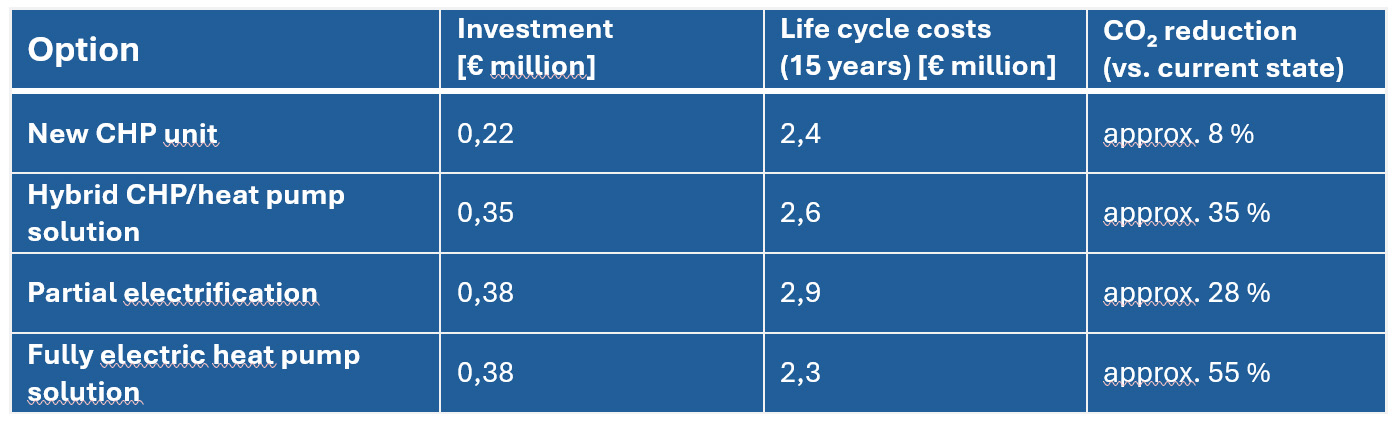
The analysis showed that the ranking of the options changes significantly once energy, maintenance, and CO₂ costs over the system’s lifespan are taken into account in addition to the initial investment costs. At first glance, the traditional CHP replacement appears particularly attractive. The acquisition costs are significantly lower than those of the heat pump options and thus often align with the investment expectations of many small and medium-sized enterprises. However, when considering costs over the entire life cycle, this advantage is considerably diminished, and the investment costs become virtually negligible.
Long-Term Operating Costs as a Key Factor
The key factor here is, above all, long-term operating costs. While CHP plants are permanently dependent on natural gas prices, CO₂ costs, and future requirements for the use of renewable gases, heat pumps shift a larger portion of the costs to the initial investment. Running costs, on the other hand, are significantly lower and, above all, more predictable.
The all-electric option was particularly interesting in this project. Despite higher investment costs, it proved to be the most economical solution over the period under consideration. Heat generation costs were around 59 euros/MWh, compared to about 84 euros/MWh for the CHP concept, which is attributable to rising costs for CO₂ taxes and the blending of synthetic gases or hydrogen. At the same time, operational greenhouse gas emissions were reduced by more than half.
Purchase Price vs. Life-Cycle Costs
This outcome is typical for many mechanical engineering companies. Production facilities, buildings, and power plants are often operated over periods ranging from 15 to 30 years. Investment decisions should therefore not be based solely on the purchase price or on achieving the shortest possible payback period.
It is far more meaningful to consider the total life-cycle costs, including energy procurement, maintenance, CO₂ pricing, subsidies, and potential regulatory risks.
Furthermore, the framework conditions have changed fundamentally since the last scheduled renewal of the heating and utility supply systems. On the one hand, subsidy and tax policies favor heat pumps over (fossil-fueled) combined heat and power (CHP) plants. On the other hand, municipal heating plans—which nearly every municipality must publish in the coming years—call for a significant reduction in gas networks; as a rule, these will be decommissioned and dismantled (across the region) by 2045.

Conclusion
The project illustrates that the most economically viable solution is not necessarily the one requiring the lowest investment. Particularly in industrial settings, heat pumps, photovoltaic systems, and smart energy systems can result in lower overall costs in the long term—despite higher initial costs—while simultaneously meeting ESG, decarbonization, and energy security requirements. Furthermore, it was once again demonstrated that an outside perspective on the entire system offers significant potential.