Successes and Challenges in GMP Projects
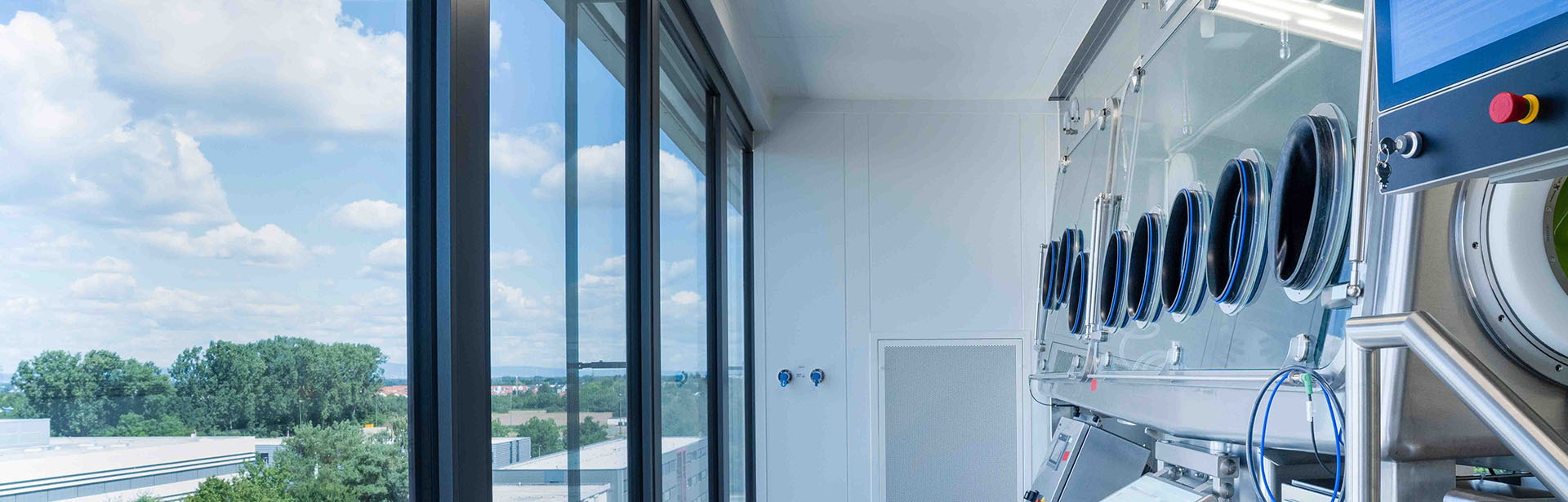
Dr. Markus Weigandt is Head of the Pharmaceutical Technologies Department and, as the project manager, has overall responsibility for the construction of a new high-containment Solida pilot plant at the Technical Development Center (TDC) on the Darmstadt campus. This new production area will be used for the development and GMP manufacturing of innovative pharmaceuticals at Merck. Dr. Ralph Sapper is a Senior Project Manager in Merck’s Global Engineering division and leads strategic projects. As the overall project manager, he is responsible for the complete expansion of Building D39.
Dr. Weigandt, Dr. Sapper, the Suite 1+2 project in Building D39 was the first in a series of three subprojects aimed at establishing an innovative and integrated development facility at Merck’s Darmstadt site. What significance does this project hold for the site, as well as for the Healthcare business division?
MW: Our Technical Development Center is certainly a flagship project for Merck Healthcare as a whole for several reasons: First of all, it serves as a technology hub and showcase of what is possible, setting an example for our GMP sites worldwide—from paperless GMP production to new and versatile manufacturing technologies to the containment concept.
We are proud to have created a safe working environment for our employees at the cutting edge of what is currently technically feasible, while also providing many additional jobs for highly qualified employees in Germany.
Third, once the TDC is fully completed, we will have the ability to internally develop and manufacture all key modalities in our healthcare pipeline—whether oral, parenteral, highly potent, cytotoxic, or poorly soluble—in-house—an invaluable advantage for bringing important new medications to patients quickly and with high quality.
What were—from the perspectives of the operator and the project manager, respectively—the biggest challenges that had to be overcome?
RS: I would say the biggest technical challenges stemmed from the requirement at the time that the systems for highly potent active ingredients had to be available up to OEB 5. At that time, Merck Technik had very little experience in designing systems subject to occupational exposure limits of less than 1 μg/m³. We’ve gained a great deal of expertise in this area over the past few years.
MW: For us, the High Containment Solida Suite represents several technological leaps forward at once—paperless manufacturing, fully enclosed handling, and new manufacturing technologies, to name just a few. This entails huge changes for our employees. As an operator, it was therefore a top priority for me to get our employees on board from the very beginning and to build up their new technical expertise step by step.
Meanwhile, the second of three subprojects is already nearing completion. What experiences and lessons have you gained from over 20 years of project work?
RS: We at Merck Technik have been involved in the D39 project since mid-2016. It’s been a long period during which io has supported us as the general planner. At the beginning, our focus was certainly on finding a competent planning partner with expertise in the occupational exposure limits (O EB5) mentioned earlier. Today, however, we’ve also realized that we must not underestimate the effort required for qualification. Unfortunately, many equipment suppliers have only minimal documentation regarding their qualification, so the project team has had to compensate for this. When the third and final construction phase is expected to be completed in 2023, my colleagues and I will have been working on the project for more than seven years with io as our planning partner by our side. A project like this simply cannot be managed without a trusting collaboration. I think the project’s success speaks for itself.
In which areas have you already noticed tangible changes or improvements as a result of implementing these lessons learned?
MW: As an operator, we’ve built up a strong engineering function over the past few years that’s closely involved from the early stages of projects. This ensures a perfect “fit for purpose” for our developments, from the design of the systems all the way through to qualification.
RS: I would definitely say plant engineering! As mentioned earlier, we’ve learned a great deal in this area at Merck. Based on feedback from the plant operator—for example, following cleaning validations—we now have a much better understanding of where the plant’s weak points lie and can minimize them in advance.
Dr. Sapper, looking ahead to future projects—what do you expect from an ideal planning partner in the GMP environment, and where do you see unique aspects and differences compared to other business areas at Merck?
RS: I’ve been with Merck for over 20 years now and have led many projects in various business units. Every project is different. Projects in the GMP environment certainly have their own unique characteristics. For example, the focus during planning is very much on the quality and functionality of the systems, which are ultimately tested very precisely during the qualification process. There is virtually no room for compromise here. That’s why it’s important for a planning partner in the GMP environment to bring this expertise and experience to the table. After all, errors, inaccuracies, and the like that occur during the planning phase can only be corrected during the qualification process at great expense in terms of time and money.