Today, production sites are highly interconnected and complex systems. They no longer consist solely of buildings and machinery, but rather of an interplay between production, logistics, IT, automation, energy supply, and—in particular—digital platforms. This integration leads to complex interdependencies within the production structure:
- Production strategies influence building design
- Material and information flows shape the layout structure
- Automation requirements alter space requirements and capital expenditures
- IT systems define process speeds and transparency
- Sustainability requirements affect site selection and infrastructure
In the context of the “Magic Triangle,” time, cost, and flexibility are in direct conflict when developing or modifying a site. The result: Deciding between different site development scenarios is not getting easier—it is becoming significantly more challenging.
Concept Planning: Approaching the Problem
The critical decisions for site development are not made on the construction site, but rather during the conceptual planning phase, after the basic feasibility has been assessed. This is the first stage in which a systematic analysis is conducted to determine what requirements a future production or logistics site must meet—and which solution options are even viable. This involves not just individual questions, but a structured overall picture that, for example, defines the production strategy, outlines the infrastructural framework, or forecasts the development of material flows and logistics structures. At its core, this process creates a robust basis for decision-making.
Conceptual planning transforms an abstract investment idea into concrete, comparable scenarios. In doing so, it reveals for the first time the actual impacts of different approaches. It is precisely during this phase that a seemingly simple question—new construction or renovation—gives rise to a nuanced exploration of possible future scenarios.
From Concept to Master Planning
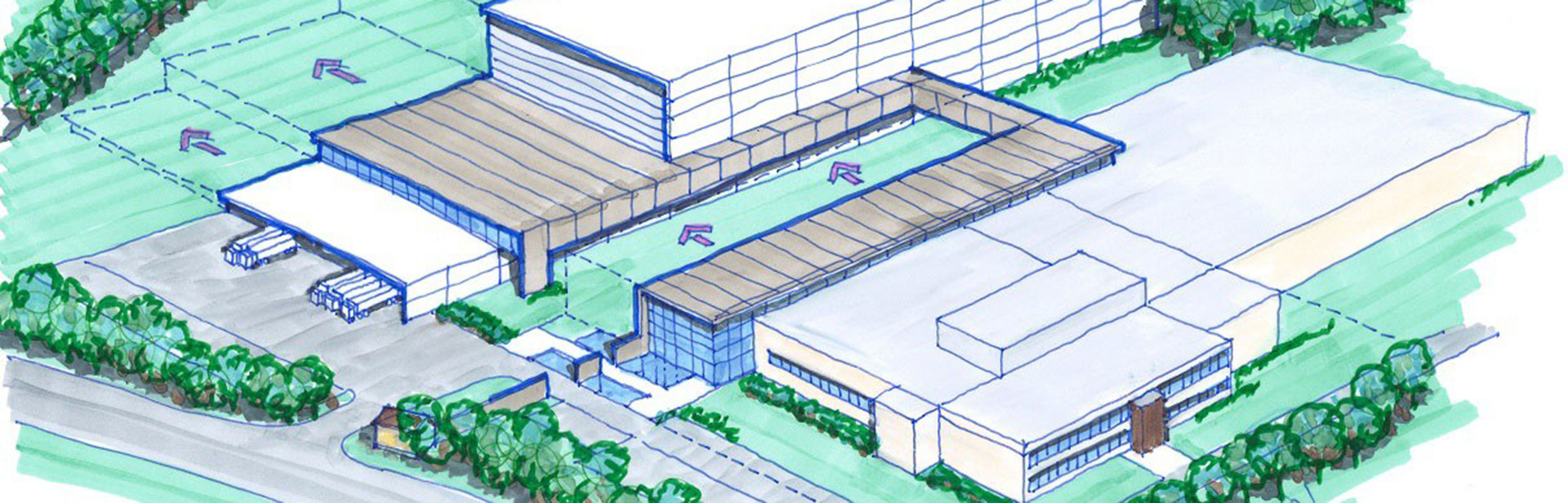
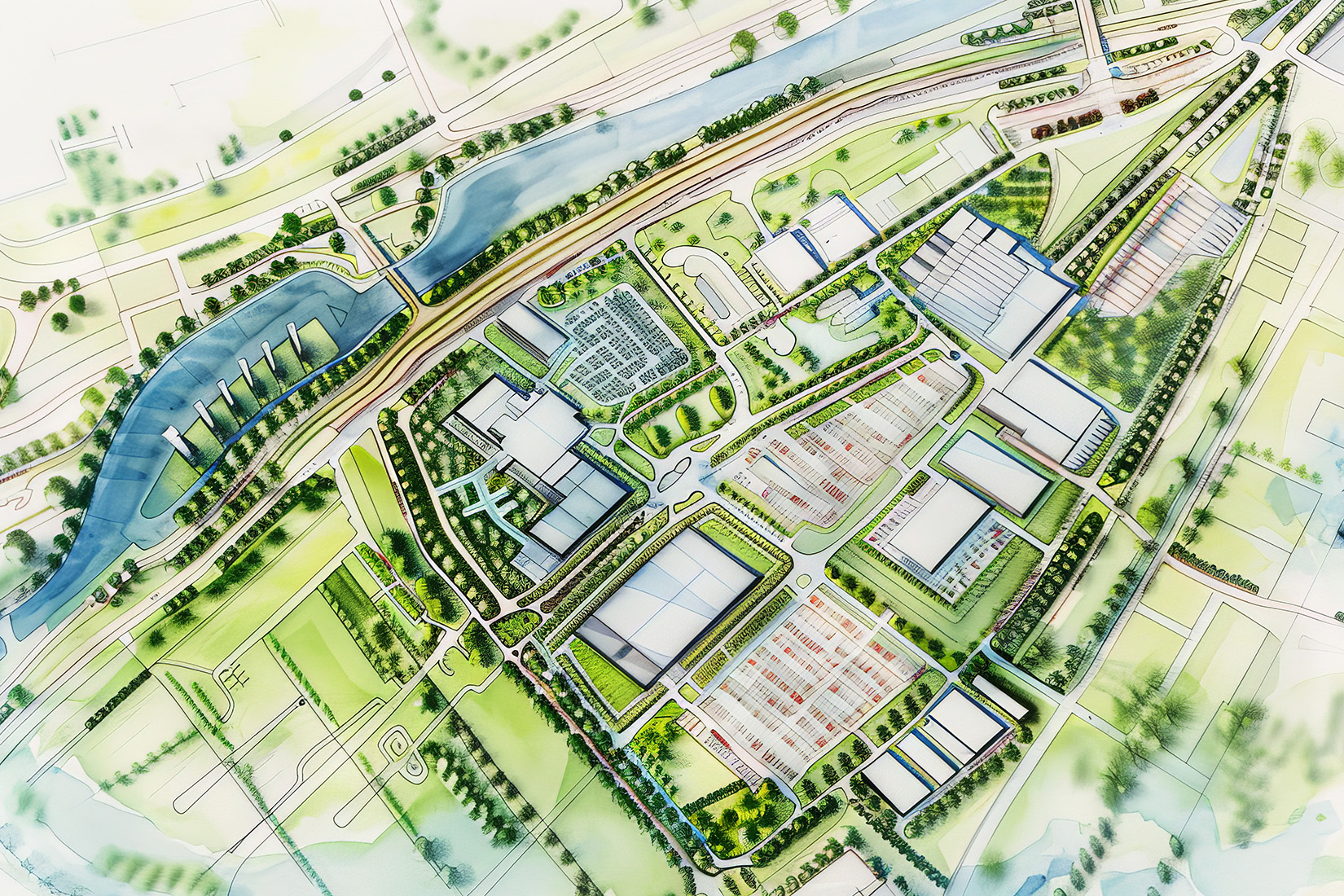
A crucial step is taken as part of conceptual planning: master planning. Here, the scenarios and solution options developed in the concept—for example, in the production layout—are not only evaluated but also translated into a consistent overall picture and a so-called real layout. Master planning links strategic objectives with concrete planning solutions. This means:
- Production, logistics, and building structures are developed in an integrated manner
- Space, utilities, and infrastructure requirements are coordinated
- Production and logistics aspects are harmonized with the site
- Expansion options and scalability are taken into account from the very beginning.
Master planning thus provides direction. It defines the framework within which a site can develop over the long term—regardless of whether it involves a new construction, the redevelopment of an existing site, or a hybrid solution.
Interdisciplinarity as a Key to Success
A building can be optimally planned—and yet still fail to align with the production strategy. A logistics concept may appear efficient—only to be hindered in operation by infrastructure constraints. The central challenge of modern site development lies in the planning of a wide variety of disciplines—including production, logistics, building services, IT, and architecture—where understanding their interactions is particularly essential. Poor decisions and inefficiencies often arise when disciplines are viewed in isolation as separate aspects.
Successful projects are therefore characterized by an integrated planning approach. Experience shows that the earlier these interrelationships are recognized and integrated, the more robust and sustainable the overall concept becomes.


Conclusion
The question “Greenfield or Brownfield?” remains relevant, but it is rarely the decisive factor. What matters most is the ability to understand the multitude of influencing factors early on, to connect them, and to derive a viable strategy for the future from them.
This is precisely where the interdisciplinary approach—from conceptual planning to master planning—comes into play. It lays the foundation for well-informed decisions, reduces risks, and opens up new creative possibilities. Because when it comes to highly complex site developments, the following applies:
It is not the supposedly simplest solution viewed from a single perspective that is the best—but rather the one that coordinates the interrelationships and harmonizes many different perspectives.