Efficiency Starts with Planning
A modern factory is far more than just a building with machines. It is the heart of value creation—a complex, dynamic system of processes, material flows, technologies, and people. This is where it is determined whether companies can react flexibly, produce efficiently, and grow sustainably.
To meet the demands placed on the factory, it takes not only good ideas but, above all, methodically thought-out, data-driven, and interdisciplinary planning. This is exactly where io comes in with its material flow and workforce flow optimization.
io follows a clearly structured project path with key milestones:
- Definition of the Starting Point
- Process and data analysis
- Process and value stream design
- Development of variants for material and personnel flows
Key aspects of this methodological approach are outlined in the following sections and pave the way from a multitude of ideas to robust and clearly structured material flow relationships within the factory.
Job Profiles as the Cornerstone of Value Creation
A smart factory always starts with a solid foundation. io creates this foundation through the systematic identification, review, and processing of relevant data.
This foundation involves creating a process requirements profile, based on factors such as quantities, batch sizes, and capacity requirements. For existing production structures, this is supplemented by an on-site assessment and analysis of current processes.
Based on this, material and personnel flow scenarios are developed for individual product families and value streams, whether for greenfield projects or brownfield sites. Using tools such as utility analysis, scenarios and variants are compared and tailored precisely to the customers’ needs. Through the development of scenarios and variants, customers receive material and personnel flow plans that provide planning certainty and minimize risks.
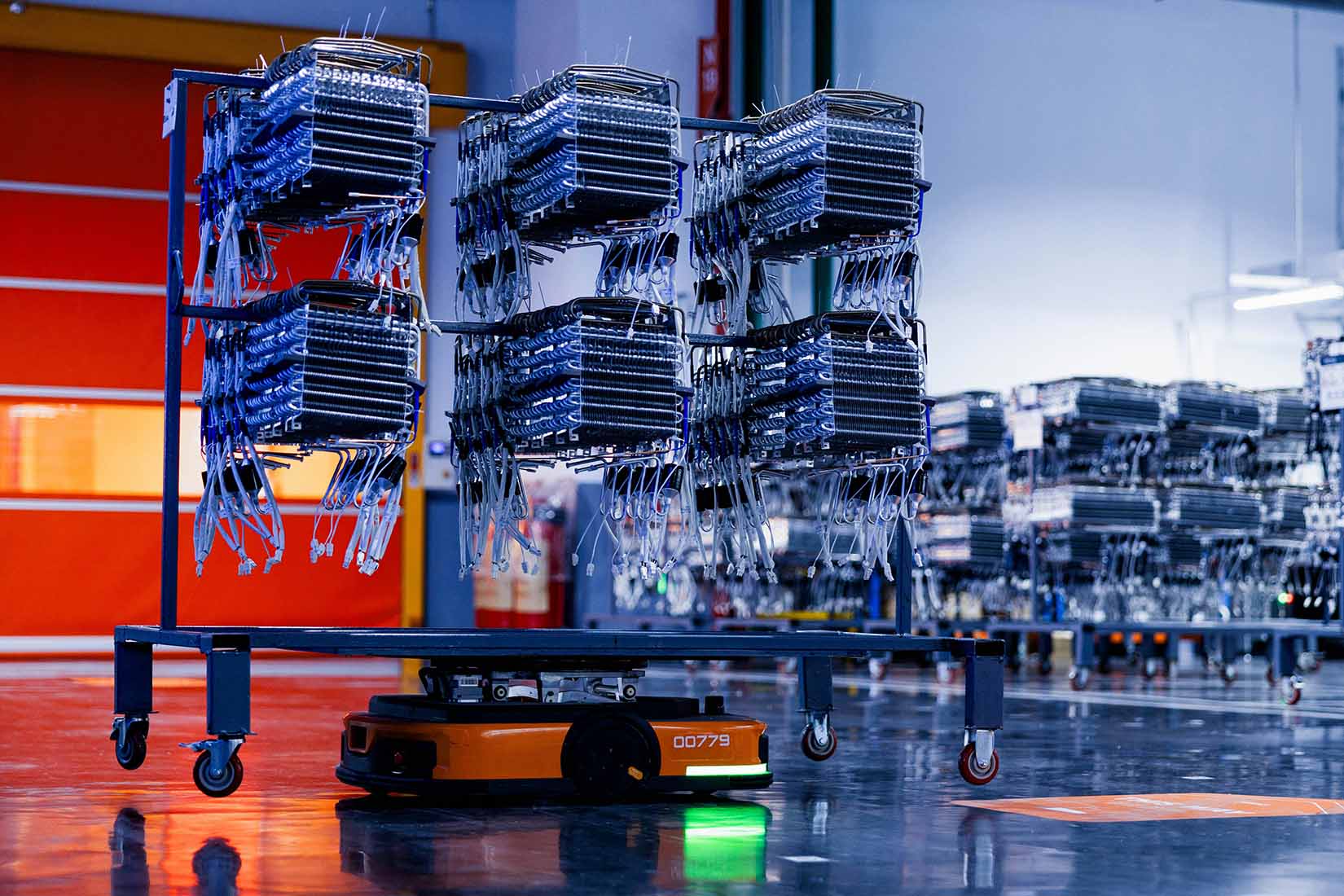
Optimizing Material and Labor Flows: Efficiently Planned from the Plant Entrance to the Plant Exit
Material and personnel flows determine how quickly, reliably, and cost-effectively a factory actually operates. That is why io focuses on process and data analysis early on, supplemented by value stream mapping, to identify bottlenecks, inventory levels, and the material and information flows of processes and resources. Based on the results of the data analysis, suitable picking, transport, and buffer systems are designed, ranging from traditional automated guided vehicles (AGVs) to highly automated systems such as AGVs/FTS. Digital models, simulations, and material flow analyses—such as those used to illustrate transport intensities—support decision-making processes and transparently highlight efficiency gains. This results in material flow concepts that not only work but also demonstrate their impact in a measurable and understandable way, with short lead times and maximum cost-effectiveness.
Short Distances: A Key Driver of Efficiency in Resource Transport
Short distances mean less transportation, fewer buffers, fewer errors, and greater speed. They are therefore not only a fundamental principle of the lean philosophy but also an economic imperative.
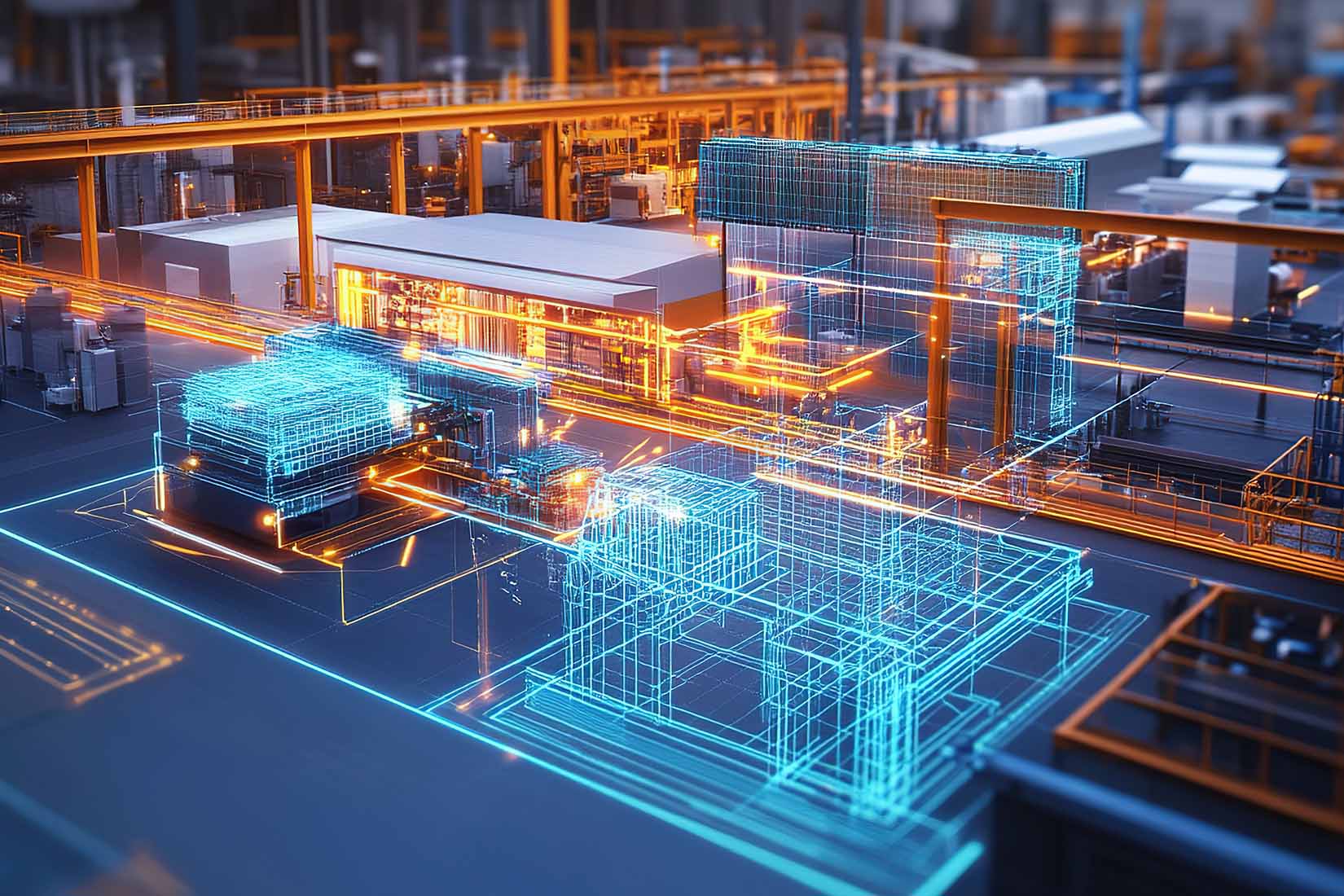
During the planning process, io develops lean layouts, using 3D tools with corresponding volume metrics to visualize, evaluate, and iteratively optimize the most important material and personnel flow relationships—those that offer customers the greatest added value—in a simple and transparent manner.
The layout is analyzed, reviewed, or redesigned based on floor space, routes, transport intensities, and the flexibility of material and personnel flows. Real-world process data, takt time specifications, and future capacity scenarios are incorporated into the planning process. The developed layouts are not only efficient but also future-proof and scalable all the way to a “digital twin.”
Smart Production Control: Pull, Kanban, and Holistic Networking
A smart factory thrives not only on automation, but also on intelligent control logic. io develops takt scenarios and Kanban loops and integrates entry and exit points of FIFO lines with intelligent pull mechanisms that are designed to be both Lean and holistically interconnected. Once again, the focus is on specific requirements. As a result, isolated solutions are not simply digitized and made more complex, but are integrated into the overall smart factory system for the long term.
io's Added Value for Decision-Makers: Structured Planning That Safeguards Investments
io’s approach yields results that are truly needed:
- robust options instead of opinions
- carefully coordinated step-by-step approaches
- Requirement-based process and material flow optimization
- simulation-based risk mitigation
- interdisciplinary collaboration between production, logistics, architecture, and IT in solution development
Io planning thus becomes your tool for direct implementation—one that protects your investments and enables growth—rather than simply disappearing into a drawer as a concept.
Let’s start the journey toward the smart factory now and plan your smart material flows together!
Would you like to modernize your production, plan a new production facility, or measurably improve existing processes? Let’s talk about your project—whether it’s a greenfield project, a brownfield project, or targeted optimization of your existing operations—we’re here for you.